
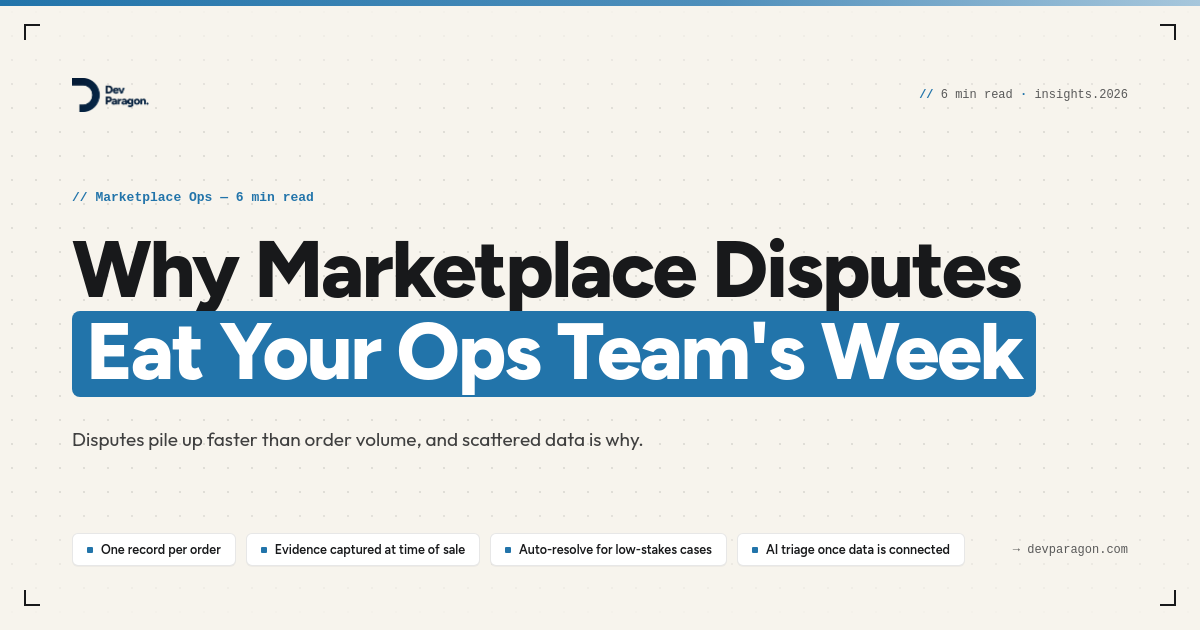
Every dispute is a scavenger hunt
Wednesday morning, a buyer opens a dispute: item never arrived. Your ops lead pulls up the order in your marketplace admin, then tabs over to Stripe to check the payment status, then digs through Intercom or a shared inbox for the message thread, then pings the seller on WhatsApp because that's where they actually respond. Forty minutes later she has enough context to make a call. Multiply that by twelve marketplace disputes a week and she's spent a full workday just assembling facts nobody bothered to store together in the first place.
That's the real cost of it. Not the refunds. The scavenger hunt.
Why marketplace disputes outgrow your team
Order volume and dispute volume don't scale together. Dispute volume scales worse. A marketplace at 500 orders a month might see eight disputes. At 5,000 orders, it's not eighty, it's often two or three hundred, because more volume means more new sellers, more edge-case categories, more first-time buyers who don't know your return window. Growth adds noise faster than it adds revenue per dispute.
Escrow makes this heavier, not lighter. Holding funds for 3, 7, or 14 days is supposed to protect buyers, but it also means a dispute can surface after the seller has already shipped a replacement, restocked inventory, or spent the money they assumed was theirs. The hold buys you a safety net and a bigger mess to untangle when something goes wrong inside the window.
And the underlying data problem compounds it. Order details live in your marketplace database. Payment and refund status live in Stripe or PayPal. The actual conversation where the buyer said "it arrived damaged" lives in a support tool, or worse, a DM. Tracking numbers live in a shipping API or a spreadsheet a seller emailed once. None of these systems know the others exist. Every dispute means manually stitching four sources into one timeline before anyone can even decide who's right.
Why the usual fixes don't hold up
Most marketplaces respond to rising dispute load with one of four moves, and each one treats a symptom instead of the cause.
Hire more support staff. This helps for about a quarter. Then order volume grows again and you're back to the same ratio of disputes to headcount, except now payroll is higher. You've scaled the scavenger hunt, not eliminated it.
Write a stricter policy. Longer escrow holds, tighter return windows, more required evidence from buyers. This reduces dispute count a little but increases dispute severity: the disputes that do come through are angrier, and sellers start complaining that their cash is locked up for two weeks over nothing. You've traded volume for friction.
Build a dispute submission form. This looks like progress because now disputes arrive structured instead of as a random message. But the form only captures what the buyer types. It still doesn't pull the order record, the payment status, or the prior message thread automatically. Your ops team still opens four tabs. You've made the intake prettier without touching the actual bottleneck.
Outsource to a BPO or freelance moderator. This buys time but adds a permanent line item, and outside reviewers make worse calls than your own team because they have less context. They're working from whatever gets pasted into a ticket, not the full picture.
None of these fixes the actual problem: the facts needed to resolve a dispute aren't connected to each other. You can add people, policy, or forms around that gap forever and it stays a gap.
The tradeoffs worth being honest about
There's no dispute process that's fast, fair, and cheap all at once. Pick two, and know which one you're giving up.
- Fast and cheap, not fair: auto-refund anything under $25 with no questions. Buyers love it, but you'll eat some fraud, and honest sellers will feel like the platform doesn't have their back.
- Fair and cheap, not fast: require full evidence from both sides before any action. Accurate outcomes, but a five-day resolution time will tank your buyer trust scores.
- Fast and fair, not cheap: a human reviews every case same-day with full context already assembled. Good outcomes, good speed, but it needs a system that hands your reviewer everything in one place, which is the part most marketplaces skip because it means real engineering work rather than a policy memo.
The third option is the only one that scales without quietly degrading trust on one side of the marketplace or the other. It's also the one that depends entirely on your data being connected before a dispute ever opens, not after.
What actually needs to be true before you can fix this
Here's the checklist we walk marketplace teams through before touching resolution policy at all:
- Every order has one record, and that record links to payment status, shipping/tracking, and message history by order ID, not by searching three systems for a name and a rough date.
- Evidence gets captured at the moment of the transaction, not requested after a dispute opens. Delivery confirmation, tracking scans, and photos at handoff should already sit on the order before anyone complains.
- Messaging happens on-platform, or at minimum gets logged back to the order automatically. If buyers and sellers negotiate over WhatsApp because your in-app chat is clunky, you have no record when it matters.
- Low-stakes cases have a defined auto-resolve rule: item not received, no tracking scan after X days, refund under $Y. That way your team's time goes to the 10% of cases that actually need judgment.
- Escrow release ties to a real signal (delivery confirmation, buyer confirmation, or a time window past last tracking scan), not just a flat calendar countdown that ignores what actually happened to the package.
Miss any of these and adding staff, tightening policy, or bolting on a form just moves the pain around.
Where AI genuinely helps with marketplace disputes, and where it doesn't yet
Once order, payment, tracking, and messages sit in one connected record, an AI agent can do real work: draft a resolution recommendation with the evidence already assembled, flag the cases that match your auto-resolve rules so a human only sees the ambiguous ones, and summarize a messy three-week message thread into two sentences a reviewer can act on in seconds.
Before that data is connected, an AI layer on top of disputes is closer to a chatbot that reads one ticket and guesses. It can't check tracking. It can't see the payment hold status. It can't tell you the buyer already got a partial refund last month for a similar issue. Bolting AI onto a fragmented dispute process just gets you a faster wrong answer, and a faster wrong answer erodes trust quicker than a slow one.
Fix the record-linking problem first. The AI layer on top becomes almost mechanical once it has one clean order record to reason over instead of four disconnected ones.
Where to start
If you're staring down a growing dispute queue, don't start with policy or headcount. Start by mapping one order end to end: payment, shipping, messages, and any prior disputes. Count how many systems your team has to open to answer "what actually happened here." That number is your real problem, and it's usually higher than founders expect.
If you want a second set of eyes on it, we run a free Process Teardown — a 30-minute session where we map one of your most painful workflows and show you the hours it's quietly costing, no obligation. We've done this for marketplaces and service platforms before; you can see some of that work in our case studies.
0 Comment